All Inclusive Holidays in Bulgaria: Value Guide
Find out if all inclusive holidays in Bulgaria really offer value. Compare regions, read the real inclusions, and check total prices against extras like
All inclusive holidays in Bulgaria can be strong value for UK families, but only when you add up flights, bags, seats and transfers, and check what the hotel really includes. A cheap-looking quote can turn into an average deal once the extras land.
You're probably staring at two or three brochure prices and wondering why the “best” one is a flight away from your nearest airport, with hold luggage, seat selection and a transfer still missing. That's the trap with Bulgaria: the destination can work brilliantly on price, but only if you compare the full holiday cost, not just the headline rate.
Table of Contents
- Why All Inclusive Value Depends on the Total Price
- What All Inclusive Actually Means in Bulgaria
- Best Regions for All Inclusive Holidays in Bulgaria
- All Inclusive vs Breakfast and Half Board for Families
- How to Compare All Inclusive Packages Like for Like
- How to Choose the Right All Inclusive Deal
- Key Takeaways for Smarter All Inclusive Bookings
Why All Inclusive Value Depends on the Total Price
The cheapest package on the screen is often the one that looks best before you've added the bits that matter. A family of four can easily be nudged into a pricier deal by seat selection, bags, airport parking, and the transfer from the airport to the resort, and the headline hotel rate tells you none of that.
Bulgaria's long-term appeal to UK package buyers is real. ABTA reported that UK trips to Bulgaria had doubled between 1994 and 2019, while summer 2019 bookings were 16% higher than the previous year, in a market where package holidays made up about half of all overseas holidays taken by UK residents and that share had stayed broadly stable since 2014 (ABTA research on summer holidays). That matters because Bulgaria is not just a cheap standalone destination, it sits inside a package market where operators have been competing on price and inclusions for years.
What the headline price usually hides
A package quote may cover the hotel, flights and sometimes transfers, but it does not always cover the extras that change your real budget. If you're comparing all inclusive holidays in Bulgaria, the right question is not “Which quote is cheapest?”. It's “Which quote is cheapest after the same extras are added?”
Practical rule: compare the trip you will actually take, not the brochure version of it.
That means checking whether the deal includes hold bags, family seating, airport transfers, and the board basis you think you're buying. It also means looking at the resort itself, because a slightly pricier hotel in the right area can save money in transfer time, taxis, and drinks once you arrive.
The destination's value story is strongest when the holiday is genuinely self-contained. Once you start paying separately for basics, the savings can shrink fast, especially for families who want predictability rather than a surprise bill at the airport or the hotel desk.
What All Inclusive Actually Means in Bulgaria
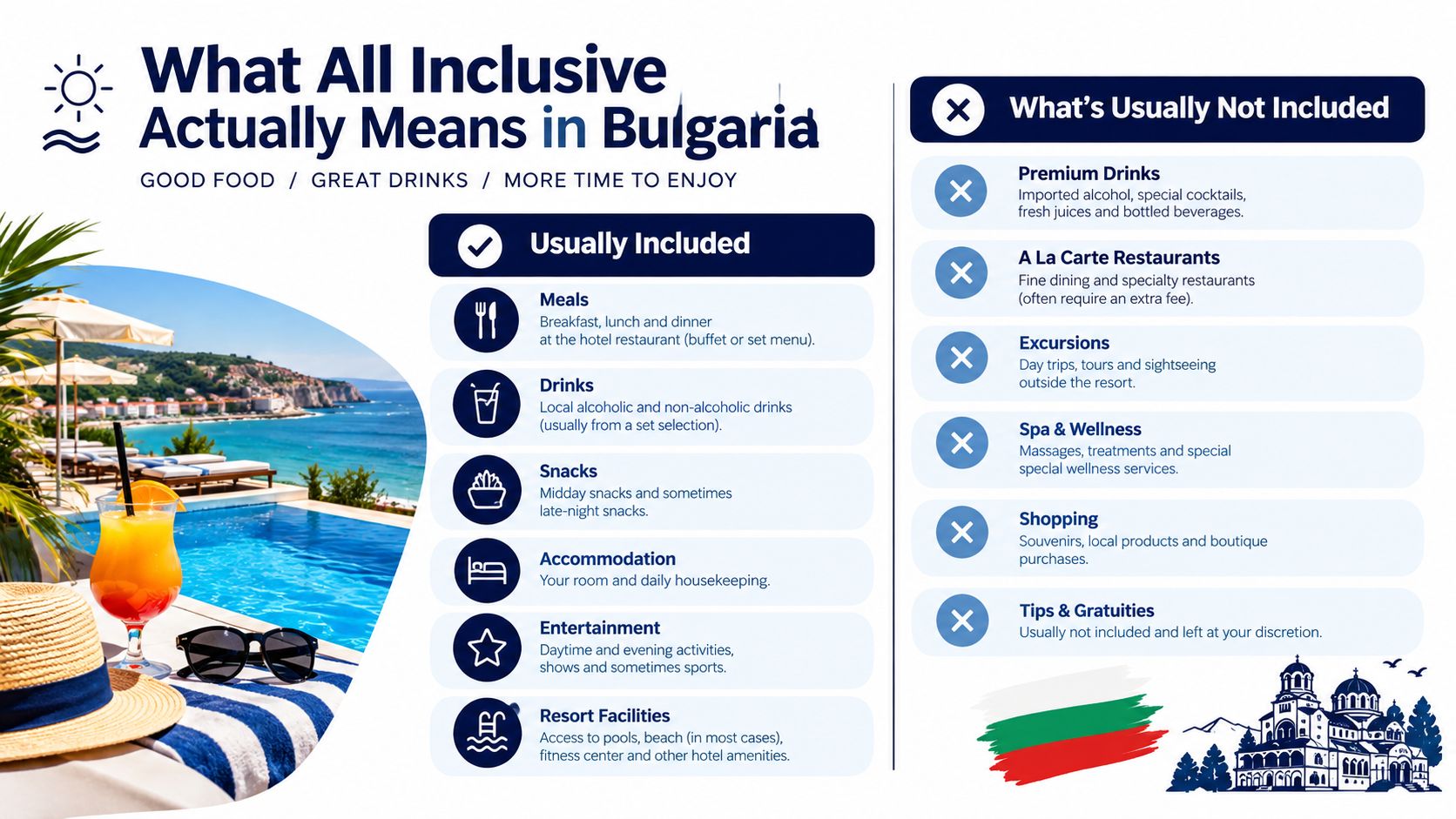
The label “all inclusive” sounds tidy, but in Bulgarian resorts it can cover very different things. One hotel may pour local drinks at set times and include buffet meals all day, while another may restrict branded spirits, bottled water, snacks, or themed restaurant visits.
A good booking habit is to treat the room-and-board description as the actual product, not the marketing headline. The same star rating can still hide different drink lists, restaurant rules, and service hours, and one Bulgaria-focused guide notes exactly that, saying standard packages may provide local drinks only at specific times, while premium products, bottled drinks and certain themed restaurants can bring restrictions or extra charges (Bulgarian all-inclusive guide).
The details that trip people up
Before you book, check the hotel fact sheet, the tour operator's room description, and the transfer terms. The small print often decides whether the holiday feels easy or irritating.
The package title can be generous while the practical inclusions are narrow.
Look for these specific points:
- Drinks policy: local drinks only, branded drinks extra, or separate premium bars.
- Food windows: snack times, late breakfasts, or limited à-la-carte access.
- Water and minibar rules: bottled water may be extra even when soft drinks are not.
- Facilities: beach sunbeds, children's clubs, spa use, and waterpark access may sit outside the tariff.
- Taxes and add-ons: tourist tax, late checkout, and room upgrades can still appear on site.
The reason this matters is simple. Two hotels can both call themselves all inclusive, yet one gives you an easy resort week and the other gives you a list of exceptions. If you're comparing like for like, compare the actual benefits, not the phrase on the results page.
Best Regions for All Inclusive Holidays in Bulgaria
Bulgaria works best when you match the region to the holiday style. The Black Sea resorts are the main summer play for all inclusive packages, while the ski areas serve a different kind of trip, especially for travellers who want resort-based convenience in winter as well as sun.
The official Bulgarian tourism data show the scale clearly. Around 343,000 UK visitors were reported, Bulgaria attracted 13.6 million international visitors in 2025, and UK demand was strong in both summer and winter, with more than 103,000 UK tourists registered in the Black Sea municipalities from June to August 2024 and about 40,000 British tourists in ski destinations during the 2023/24 winter season (Bulgarian tourism data).
Beach resorts and who they suit
Sunny Beach is the obvious choice for lively summer packages, especially if you want lots of hotel stock, bars, and easy family beach access. Golden Sands tends to suit travellers who want a similar coastal setup with a different feel, while Albena and Riviera are the sort of places many families choose when they want a more contained resort and a calmer pace.
The value angle changes by resort. In a busier strip, you may find more choice and sharper competition, but also more temptation to spend outside the hotel. In a quieter resort, all inclusive can make more sense because you're less likely to wander out for every meal and drink.
Winter options without the beach hype
Bulgaria's ski destinations are not the same decision, but they matter if you travel outside summer. Resorts such as Bansko, Borovets and Pamporovo are often chosen for convenience, especially when travellers want meals sorted and a predictable base after a day on the slopes. That mix appeals to active couples and families who prefer a contained trip over a complicated DIY itinerary.
The practical rule is simple. If you want a beach week with almost everything on site, focus on the Black Sea. If you want a winter break with hotel-based convenience, look at the ski resorts instead. The wrong region can make a good-priced package feel awkward, even if the initial quote looked attractive.
All Inclusive vs Breakfast and Half Board for Families
Bulgaria's recent demand pattern shows why this comparison matters. The country recorded 40,763 UK holiday visits in August 2025, total foreign holiday visits topped 1.19 million that month, up 6.3% year on year, and tourism revenue reportedly grew faster than visitor numbers, by 16% year on year (August 2025 tourism figures). That suggests more people are going, and the spend per trip may be moving too.
For a typical UK family, all inclusive wins when the holiday is built around the resort. If you eat three meals on site, want plenty of drinks, and have young children who snack through the day, the board basis can remove a lot of friction. It's also useful if you want budget certainty before you travel.
When half board can be better
Half board often works better for lighter eaters and for families who like to spend their days out of the hotel. If you plan excursions, eat a late lunch elsewhere, or only want breakfast and dinner fixed, all inclusive can overpay for food and drink you won't use.
A cleaner way to decide is to compare three things at the same resort and dates:
- All inclusive total, including the package extras.
- Half board total, plus the food and drinks you know you'll buy.
- Bed and breakfast total, plus your likely lunch and dinner spend.
That comparison matters because the cheapest board type is not always the cheapest holiday. A family that stays by the pool all day may spend more on drinks and snacks under half board than they expected. A family that spends most days exploring may pay for a lot of unused buffet coverage on all inclusive.
The point is not that one option is always best. It's that the board basis should match the way your family travels, not the way the brochure copy assumes you will.
How to Compare All Inclusive Packages Like for Like
The cleanest comparison starts with one principle. Compare the same hotel, same dates, same room type, same travellers, and the same board basis, then add the costs that often get left out of the first screen. That's the only way to know whether the “deal” is actually cheaper.
Begin with the package fare, then add the likely extras. Different UK departure airports can change the fare, and so can hold bags, pre-booked seats, airport parking, transfers, car hire, and travel insurance. If one quote includes transfers and another doesn't, they are not the same deal.
Do not compare a package price against a fantasy price. Compare it against your actual travel plan.
A practical workflow is to build a total for each quote in a simple note or spreadsheet. Put the hotel name, departure airport, baggage allowance, seating cost, transfer type, and any parking or insurance on one line. Then compare the true totals, not the homepage figures.
When you want a broader comparison, useful tools can help you benchmark the same package across more than one operator. For a practical example of how package comparison works in the UK market, see this guide to the cheapest package holiday company. The important habit is to stay exact. If the hotel, board basis, date, or room type changes, the result is no longer like for like.
ATOL protection also matters when you're booking a package through a UK provider. It doesn't make a holiday cheaper, but it does change the risk profile, which is part of the value calculation if you're spending a family budget rather than a weekend away amount.
How to Choose the Right All Inclusive Deal
The best deal is usually the one that clears three tests at once. It fits the right resort, it includes what you need, and the full trip cost still beats the alternatives once the extras are added. Miss one of those tests and a bargain can become a compromise.
Start with the resort. If you want a lively beach strip and lots of hotel choice, a Black Sea resort may suit you. If you want a quieter base, choose one of the calmer coastal areas. If you're booking winter travel, the ski resorts are the more relevant filter, not the beach towns.
Then check the inclusions. The phrase “all inclusive” is not enough, because branded drinks, bottled water, themed restaurants, beach facilities and children's services can all differ. That's the point where most travellers get caught out.
Finally, run the money check. Add flights, bags, seats, transfers and parking, then compare the total against breakfast or half board. That's where the value shows up, and it's the only way to know whether the hotel price is good or just formatted well.
For a practical team view on deal hunting, this Dealbeaters team page can help you understand how like-for-like package comparison is approached from the UK market side. Use that mindset when you book, because the right deal is the one that survives scrutiny, not the one that looks cheapest in a search result.
Key Takeaways for Smarter All Inclusive Bookings
The smartest Bulgaria booking is usually the one that resists the first headline price. Compare the full holiday cost, check the exact inclusions, and only then decide whether all inclusive is better than breakfast or half board.
A short checklist helps:
- Confirm the total cost, including bags, seats, transfers and parking.
- Read the board description, not just the hotel title.
- Check drinks and food rules, especially for branded items and restaurants.
- Match the resort to the trip style, lively beach, quiet coast, or winter ski base.
- Compare like for like, same hotel, dates, room, and number of travellers.
If you want a broader view of package comparisons and deal-checking methods, the Dealbeaters blog is a useful place to start. Use it as a way to sanity-check the brochure price before you commit, especially if you're booking for a family and every extra quickly adds up.
If you're comparing Bulgaria package deals and want to see whether a headline price really holds up, Dealbeaters checks the same trip against like-for-like options across UK travel providers. It's a practical way to see the full cost before you book, which is exactly what matters when bags, seats and transfers can change the outcome.
Prepared with the Outrank tool